From 180 Stereo-Cameras to 12 Lidar Sensors: Rethinking People Flow Analytics in Retail
How SAIMOS uses Hesai XT32 lidar to reduce sensing infrastructure while supporting people counting, dwell-time, heatmapping and statistics in complex retail environments
Understanding how people move through a retail environment can provide valuable insight into how physical spaces are used. People flow analysis looks at factors such as visitor numbers, movement paths, dwell-times, activity levels across different areas and how these patterns change over time. This information can help retail managers better understand footfall, identify areas of high activity and assess how people move through a space over time.
Capturing that information consistently across a large environment, however, can require substantial sensing infrastructure. Corridors, open entrances, architectural elements and changing layouts can all influence sensor placement and coverage. Temporary promotional areas add another variable, as the physical environment may change while the requirement for reliable movement data remains.
For one large retail environment, these challenges led to a reconsideration of the originally planned sensing architecture. SAIMOS has a 3D lidar analytics platform built around its SAIMOS Control Center, geo-database and geospatial-analytics capabilities. For this project, SAIMOS proposed an alternative approach using Hesai XT32 lidar to provide the spatial data for people counting, heatmapping and movement analysis.
Instead of the large network of ceiling-mounted stereo cameras originally planned, the final solution uses 12 Hesai XT32 lidar sensors.
The result was a significantly more compact sensing architecture: 12 lidar sensors instead of the 180 stereo cameras originally planned.
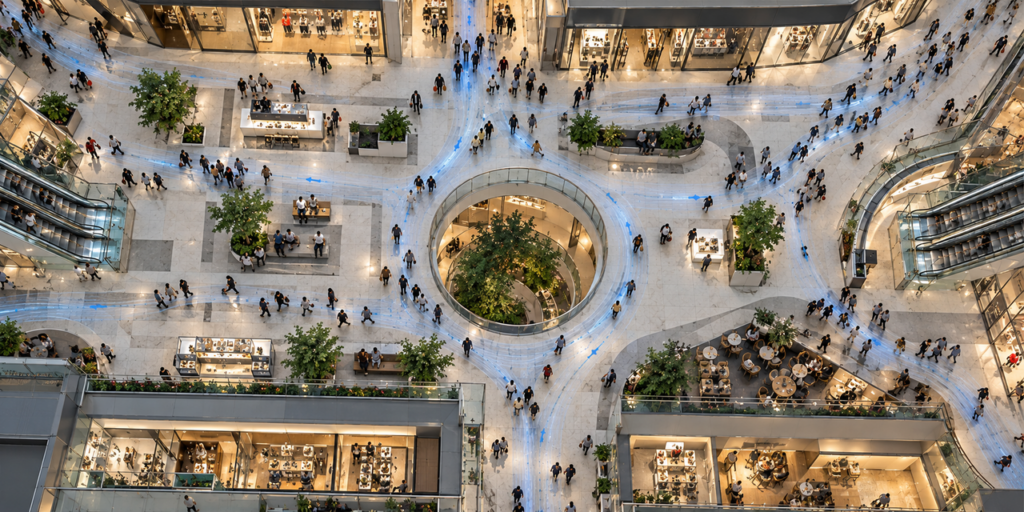
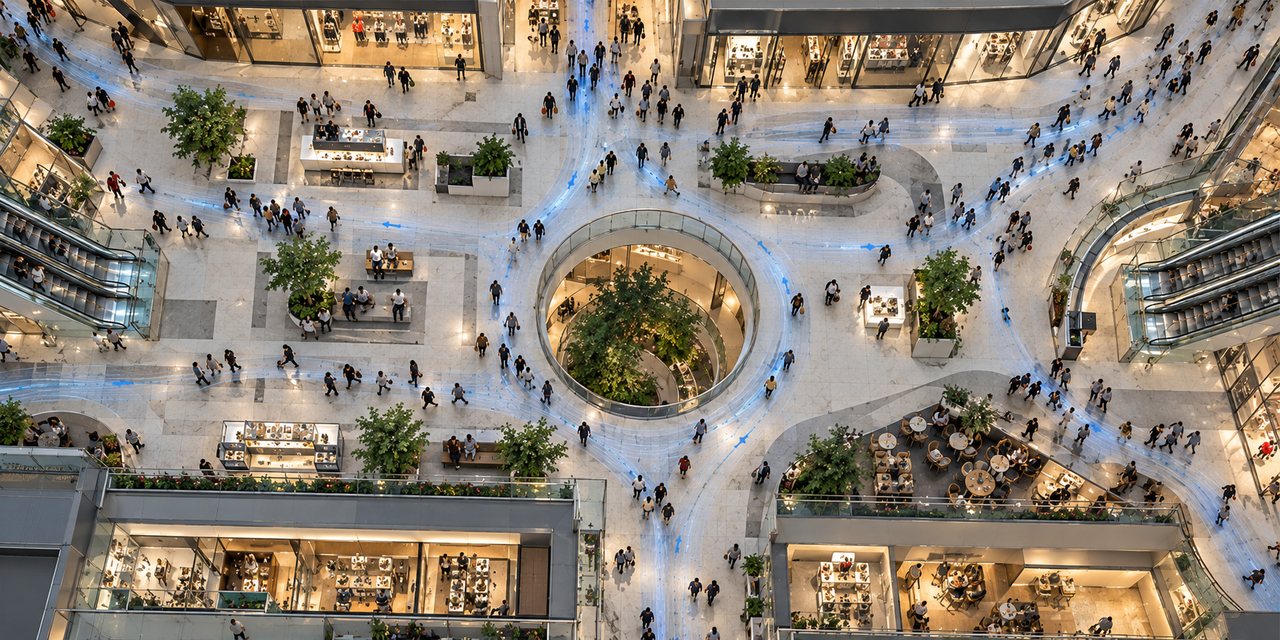
People flow analytics can reveal how visitors move through a retail environment and where activity is concentrated.
When the original sensing concept became impractical
The original system design relied on a large number of ceiling-mounted stereo cameras to provide coverage across the retail environment.
As the project developed, the physical characteristics of the space created additional constraints. Planned ceiling elements would have obstructed some of the intended camera views, while the overall number of cameras also increased hardware, installation and infrastructure requirements beyond the original budget.
Following consultation with SAIMOS, the sensing architecture was redesigned around 3D lidar.
The final solution combines Hesai XT32 sensors, SAIMOS 3D lidar software and the SAIMOS Control Center. According to the project documentation, the system supports people counting, dwell-times, heatmapping, and statistical analysis of visitor movement across the environment.
Rather than simply replacing one sensor type with another, the redesign changed the overall sensing architecture and substantially reduced the number of sensing positions required.
From 3D measurements to people flow insight
Lidar measures the surrounding environment in three dimensions, generating spatial data that can be processed to understand objects and movement within a defined area.
Within the SAIMOS solution, data from the Hesai XT32 sensors forms the sensing layer behind the analytics platform. Real-time and historical data is stored in the SAIMOS geo-database, where geospatial-analytics are applied through the SAIMOS Control Center.
Results can be viewed through a map-based interface, including detailed information for individual areas of the space, as well as dashboards for real-time and historical analysis.
This allows the platform to generate people counts, heatmaps and movement information from the spatial data collected by the lidar sensors.
According to Hesai, 3D lidar enables positional accuracy of better than 10 cm when detecting people, maintaining consistent performance across relevant sensing distances. This level of precision supports accurate tracking of movement paths and reliable measurement of dwell times within defined areas.
For retail operators, this goes beyond knowing how many people enter a location. People flow analysis can help show where activity is concentrated, how visitors move between different areas and how patterns develop over time.
This becomes particularly relevant in large retail environments where open entrances, connected spaces and temporary installations can influence how people navigate the site.
Hesai XT32 provides the 3D spatial data used by the SAIMOS platform for people counting, heatmapping and movement analysis.
Fewer sensors, less supporting infrastructure
One of the strongest outcomes of the redesign was the reduction in hardware.
The original architecture would have required 180 stereo cameras. The final design uses 12 Hesai XT32 lidar sensors, with four sensors providing seamless coverage on each floor sized approx. 110 m x 20 m.
Reducing the number of sensing positions also reduced the surrounding infrastructure. SAIMOS reports lower requirements for network infrastructure and less installation effort related to cabling, switches and other supporting hardware.
According to SAIMOS, the lidar-based approach resulted in a minimum saving of €200,000 compared with the originally planned stereo-camera system. The comparison includes the planned camera deployment versus the complete SAIMOS solution, including sensing devices, software licences and servers. Further savings were identified in physical installation, cabling and network infrastructure.
The project illustrates why the number of sensing devices matters beyond hardware cost alone. Every additional installation point can also require mounting, cabling, network connectivity, configuration and ongoing infrastructure support.
The role of Hesai XT32
The final installation uses 12 Hesai XT32 lidar sensors, with four sensors providing seamless coverage on each floor.
For SAIMOS, the XT32 offered a strong balance between value and point-cloud density. The sensor provided the level of 3D data required for the analytics application while keeping network traffic within practical limits for the overall system architecture.
This combination made the XT32 a good fit for a deployment where both sensing performance and overall system efficiency were important. Rather than maximising point-cloud density beyond the needs of the application, the solution was designed around the level of spatial data required to support reliable people flow analytics.
Supporting changing retail layouts
Retail environments can change regularly as temporary promotional booths and other installations are moved or replaced. For this project, flexibility was therefore one of the original requirements for the sensing solution.
Because four XT32 sensors provide seamless coverage of each floor, changes to temporary installations do not require the lidar sensors to be repositioned.
The SAIMOS platform also does not require changes to its heatmapping, counting or retention-time configuration when the layout changes. Spatial data is continuously stored in the SAIMOS geo-database and analysed across both time and location using geotemporal analytics.
This allows operators to query how different areas have been used over time even as the physical environment changes.
Turning people flow data into lasting retail insight
The project shows that effective people flow analysis does not have to depend on dense sensing infrastructure. By combining 12 Hesai XT32 lidar sensors with SAIMOS geospatial-analytics, the deployment reduced hardware, installation and network requirements while still providing the spatial data needed for people counting, heatmapping, movement analysis and retention-time insights.
Since going live in Q1 2024, the system has continued to generate both real-time and historical spatial data as the retail environment changes.
For operators, the value goes beyond counting visitors: the solution helps show where activity takes place, how movement patterns develop and how physical space is used over time.
Q&A
What lidar is used for people flow analysis in the SAIMOS retail deployment?
The deployment uses 12 Hesai XT32 lidar sensors as the 3D sensing layer for the SAIMOS people flow analytics solution. The lidar data supports people counting, heatmapping, movement analysis and geotemporal analytics across the retail environment.
Why was Hesai XT32 selected for retail people flow analytics?
Hesai XT32 was selected for its balance of value, point-cloud density and network efficiency. The sensor provides the level of 3D spatial data required by the SAIMOS analytics platform without generating unnecessary network traffic for the overall system.
How does Hesai XT32 lidar support people counting and heatmapping?
Hesai XT32 sensors provide 3D spatial data that is collected in the SAIMOS geo-database. SAIMOS applies geo-analytics to this data to generate people counts, heatmaps, movement information and historical spatial analysis through the SAIMOS Control Center.
How many lidar sensors are used in the retail people flow system?
The final deployment uses 12 Hesai XT32 lidar sensors, with four sensors providing seamless coverage on each floor. The original sensing concept had called for 180 stereo cameras.
How does 3D lidar reduce infrastructure requirements for retail analytics?
In this deployment, replacing the originally planned 180 stereo cameras with 12 Hesai XT32 lidar sensors reduced the number of sensing positions and the associated requirements for cabling, switches, network infrastructure and physical installation.
How does lidar support changing retail layouts?
Four Hesai XT32 sensors provide seamless coverage of each floor, so temporary promotional areas can change without requiring the lidar sensors to be repositioned. SAIMOS uses geotemporal analytics to analyse collected data across both space and time without requiring changes to the core counting, heatmapping or retention-time configuration.
What is the advantage of 3D lidar for accurate people flow analysis?
According to Hesai, 3D lidar provides sub-decimetre positional accuracy for detected persons, with positional accuracy remaining stable across the relevant sensing distance. This supports precise geolocation of movement tracks and retention-time analysis.
What cost savings did the lidar-based retail analytics system achieve?
SAIMOS reports a minimum saving of €200,000 compared with the originally planned stereo-camera architecture. The comparison includes sensing devices, software licences and servers, with additional savings from reduced cabling, network infrastructure and physical installation.