Hesai Releases Spatial Intelligence White Paper on Technological Evolution, Industry Trends, and Application Opportunities
November 10, 2026 – Hesai Group (Nasdaq: HSAI; HKEX: 2525) (“Hesai” or the “Company”), a Physical AI infrastructure company, today released its Spatial Intelligence White Paper (the “White Paper”) globally. The White Paper examines the technological evolution, industry trends, and application opportunities of spatial intelligence and highlights key developments in Hesai’s 3D world data engine, Kosmo. It identifies a critical bottleneck facing the Physical AI industry: while AI models are advancing rapidly, the supply of real-world data is struggling to keep pace. The ability to generate and deliver high-quality, multimodal 3D spatial data at scale is becoming an essential component of the infrastructure needed to advance Physical AI.
Over the past decade, AI has evolved from reading and generating text to developing an initial ability to understand and reason about the 3D world, moving beyond digital environments and into the physical world. To operate effectively in real-world environments, AI must go beyond identifying objects. It needs to understand where objects are, how they relate to one another, how the surrounding environments are structured, and how they may change over time, so that it can make decisions and take action accordingly. The White Paper defines this capability as spatial intelligence: the ability of an intelligent system to establish a complete loop of perception, understanding, reasoning, and interaction based on real-world spatial information. This enables AI not only to understand the world but also to interact with it.
The White Paper identifies spatial intelligence as an emerging source of opportunity across trillion-dollar industries, with applications spanning world models and generative AI, embodied AI, film and entertainment, and cultural tourism and heritage. At the same time, different industries have distinct requirements for 3D spatial data across two key dimensions: scale and quality. World models and generative AI require extensive and diverse real-world scenarios, placing a premium on data scale. Embodied AI requires a balance of data scale and rich geometric, semantic, and physical attributes. Film and entertainment prioritize visual realism, geometric consistency, and multi-view stability, while cultural tourism and heritage place greater emphasis on geometric accuracy, textural detail, and authenticity. As spatial intelligence moves toward large-scale deployment, the industry needs more than standalone tools. It requires full-stack platforms capable of producing high-quality data at scale in a standardized manner and connecting different parts of the value chain to build a broader ecosystem. Kosmo, Hesai’s 3D world data engine, was developed to address this need.
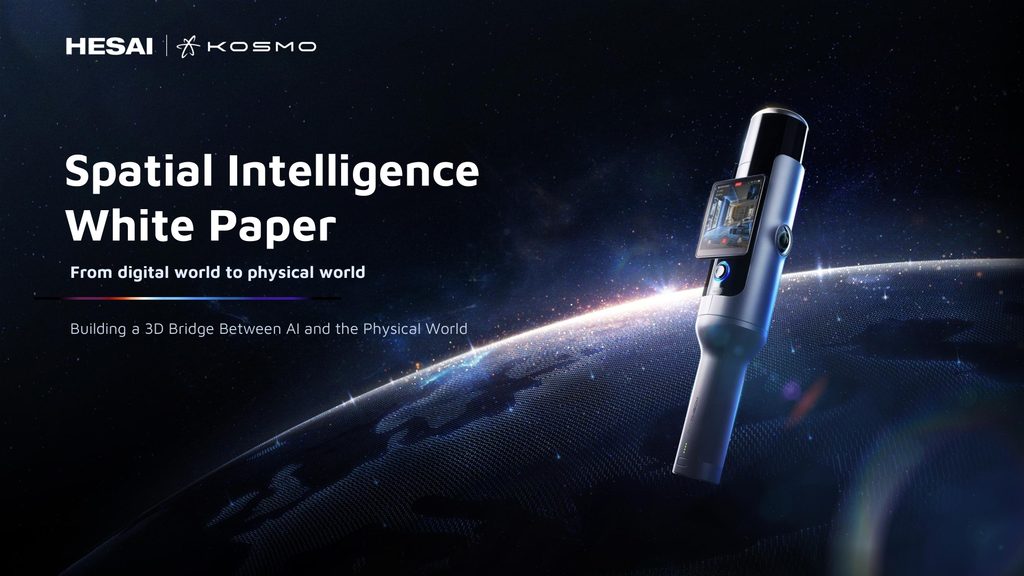
Kosmo combines Kosmo One, the world’s first 8K ultra HD AI spatial camera (1), with the Kosmo World cloud platform. Kosmo One captures real-world environments as detailed, reusable 3D digital assets, while Kosmo World, a one-stop platform for 3D content creation and management, transforms the captured data into high-quality 3D models and simulation-ready environments. Together, they provide real-world data needed for embodied AI training and world model development, while also enabling creators to capture real-world spaces and develop immersive content.
Positioned in the upper-right quadrant of the spatial data demand matrix, where both data scale and quality requirements are high, Kosmo is initially addressing one of the industry’s most challenging data supply problems. Its focus is on high-value applications with strong demand for 3D data and high barriers to entry. Kosmo’s current applications fall into two primary categories: sim-ready, which supports world models, generative AI, and embodied AI by providing real-world 3D data for model training, robot simulation, and validation; and production-ready, which serves film and entertainment, and cultural tourism and heritage by streamlining 3D content creation and enabling the reuse of digital assets.
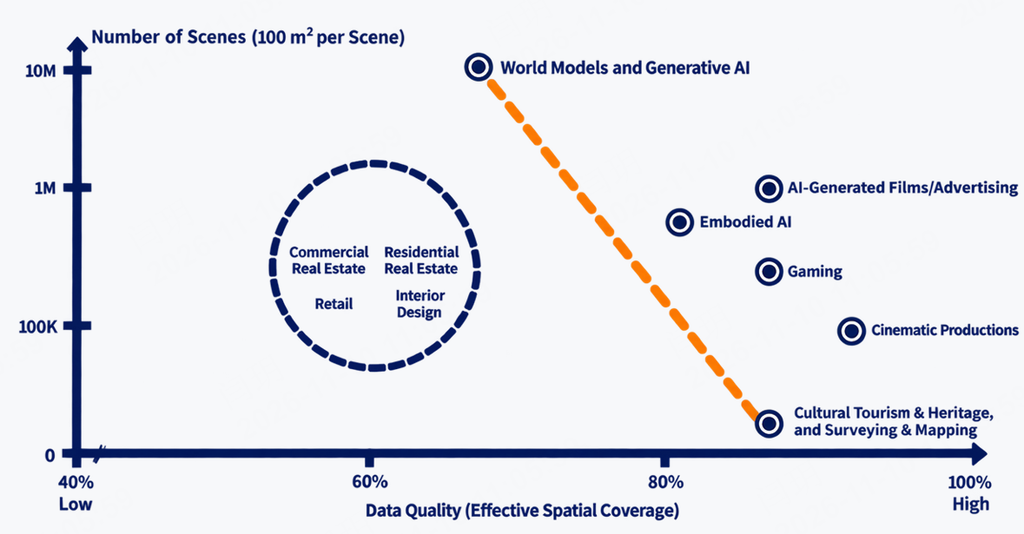
Spatial Data Demand Matrix: Quality vs. Scale
Looking ahead, Kosmo will continue to leverage its integrated hardware and software capabilities to scale the supply of high-quality real-world 3D data and the applications that use it. By collaborating with leading ecosystem partners, Kosmo aims to accelerate the development and adoption of spatial intelligence technologies and applications, providing a solid foundation for Physical AI.
Read and download the full Spatial Intelligence White Paper:
https://www.hesaitech.com/whitepaper/the-2026-spatial-intelligence-white-paper
(1) Based on publicly available product information as of October 2026, Kosmo One is the world’s first AI spatial camera with an integrated 8K imaging system.