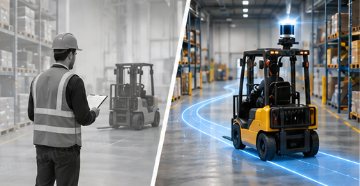
A digital approach to capturing indoor forklift routes with lidar and SLAM, creating repeatable movement data for operational analysis.
In production plants, forklifts connect material storage, production lines and other parts of the manufacturing process. Understanding how those vehicles actually move through a facility can provide useful insight into material flows, traffic patterns and the use of available space.
For one industrial manufacturer, those movements were being documented manually. A person physically followed forklifts through the production site and recorded their routes using paper and pen.
The process required considerable manual effort, depended on individual observation and placed personnel close to moving industrial vehicles while measurements were being collected.
To create a more systematic approach, the manufacturer worked with Visimind, a Hesai distribution partner with experience in geospatial and positioning solutions, to develop a digital method for capturing forklift movements.
From Manual Observation to Digital Forklift Tracking
The resulting solution was IDL, the Industrial Device for Location.
IDL combines lidar with SLAM, or simultaneous localization and mapping, to determine how a forklift moves relative to its surrounding environment and digitally record its trajectory.
Lidar is particularly well suited to this task because it measures the physical environment around the system. Combined with SLAM, these spatial measurements make it possible to track movement through an indoor facility without relying on satellite positioning or requiring a person to manually document each route.
For forklift movement studies, this changes the measurement process in several ways:
- Less manual observation: Personnel no longer need to physically follow forklifts and record routes by hand.
- Reduced exposure to vehicle traffic: Data can be collected without an observer continuously walking alongside moving industrial vehicles.
- Repeatable data capture: Forklift trajectories are recorded digitally using the same measurement approach rather than depending on individual observations.
- Structured movement data: Recorded routes can be processed and visualized for further analysis.
- Multi-site use: The same IDL units can be used across different facilities rather than developing a separate measurement method for every plant.
The result is not simply a digital map of a facility. IDL creates a record of how forklifts actually move through that space.
HESAI XT32 forklift installation by Visimind
From Forklift Routes to Spaghetti Diagrams
One way to turn this trajectory data into a useful operational view is through a spaghetti diagram.
A spaghetti diagram overlays movement paths within a defined area. As multiple routes are plotted together, the visualization begins to show how vehicles, people or materials repeatedly move through the space.
In manufacturing and logistics environments, spaghetti diagrams are commonly used to examine movement and material flow. For forklift operations, they can support questions such as:
- Which routes are used most frequently?
- Where do forklift paths repeatedly intersect?
- Are vehicles regularly taking indirect or longer routes?
- Which parts of a facility experience concentrated traffic?
- Are some areas used considerably more or less than others?
The diagram itself does not determine whether a process should be changed. Instead, it gives operations teams a clearer basis for investigating movement patterns, layouts and workflows.
For the IDL project, Visimind provided the hardware and trajectory-capture solution, while the customer used its own analytical software to evaluate the resulting data.*
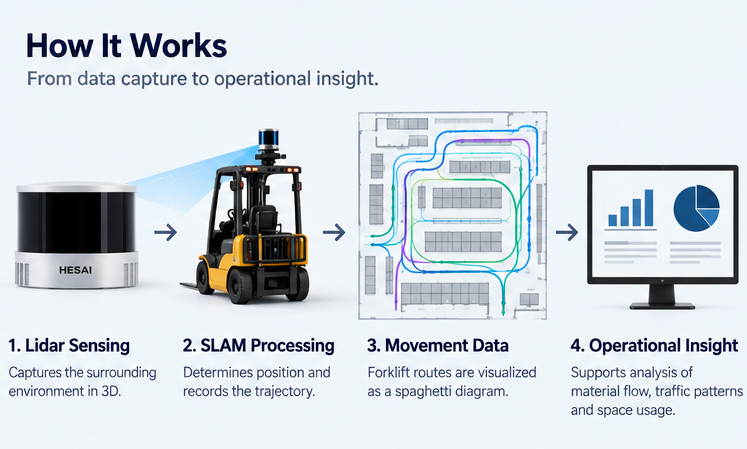
Four steps of the Visimind IDL solution
Matching the Lidar to the Application
For IDL, the lidar needed to provide the spatial data required for reliable SLAM-based positioning and trajectory capture while remaining well matched to the needs of an indoor industrial application.
The Hesai XT32 offered the right balance of technical performance, system value and cost for this task. It provided the lidar input needed for localization and movement tracking without adding unnecessary complexity or capability beyond the requirements of the application.
This made the XT32 a fit-for-purpose component within the wider IDL system.
Manual vs. Digital – from time-consuming observation to a systematic, data driven approach
12 IDL Units for Multi-Site Deployment
Following development, Visimind produced 12 IDL units for the manufacturer.
The devices were circulated among several production facilities during the project period, allowing the same measurement approach to be used across multiple sites.
Compared with the previous manual process, IDL created a more structured way to capture forklift movements while reducing the need for personnel to follow vehicles through active production areas.
More importantly, it transformed forklift movement from something that had to be manually observed into data that could be recorded, visualized and analyzed.
For industrial manufacturers, this type of approach opens a broader opportunity. Understanding physical operations increasingly depends on understanding how equipment, materials and people move through real environments. Lidar can provide the spatial foundation for capturing that movement, while applications such as IDL turn it into information that operations teams can work with.
By combining fit-for-purpose sensing with digital trajectory capture, the IDL project demonstrates how lidar can support more systematic analysis of everyday industrial processes without overengineering the solution.
*The customer’s analytical software, site data, resulting spaghetti diagrams and operational findings were not shared with Visimind. Customer-specific results are therefore not included in this article.
FAQ
How does lidar forklift tracking work indoors?
Lidar measures the surrounding physical environment using laser-based distance measurements. When combined with SLAM, these measurements can be used to determine how a system moves through an indoor space and record its trajectory. This allows forklift routes to be captured digitally without relying on GNSS.
What are the advantages of digital forklift tracking compared with manual observation?
Digital forklift tracking reduces the need for personnel to physically follow vehicles, creates repeatable trajectory data and provides structured movement information that can be visualized and analyzed. It can also make the same measurement approach easier to apply across multiple facilities.
What is a spaghetti diagram in manufacturing?
A spaghetti diagram is a visualization that shows movement paths within a defined area. In manufacturing, it is commonly used to examine how people, vehicles or materials move through a production environment and to identify recurring movement patterns.
How are spaghetti diagrams used for forklift route analysis?
Multiple forklift trajectories can be plotted together to show frequently used routes, intersections, repeated detours, concentrated traffic areas and differences in how parts of a facility are used. Operations teams can then use these patterns as a basis for further process or layout analysis.
Can lidar track forklifts indoors without GNSS?
Yes. Indoor environments often have limited or no access to satellite positioning. Lidar combined with SLAM can use measurements of the surrounding environment to support localization and trajectory recording without relying on GNSS.
Why was the Hesai XT32 selected for the IDL solution?
The Hesai XT32 provided the spatial data required for SLAM-based positioning and trajectory capture while offering a strong balance of technical performance, system value and cost for the application.
What is IDL for forklift tracking?
IDL stands for Industrial Device for Location. Developed by Visimind, it combines lidar and SLAM to digitally record forklift movement trajectories inside production facilities. The resulting data can then be used for movement visualization and further operational analysis.