The Bike That Rides Itself Back: How AutoBike Uses Hesai Lidar to Explore Smarter Bike-Sharing
An ETH Zürich student project shows how 3D lidar can support autonomous bike-sharing redistribution, starting with a proof-of-concept ride across campus.
Bike-sharing works best when bikes are available where people need them.
In practice, that balance is hard to maintain. Morning commuters may empty stations near train hubs. Other stations fill up throughout the day. At some locations, users arrive and cannot find a bike. To keep the system working, operators often have to move bicycles manually across the city.
That usually means vans, staff, repeated routes, battery swaps, and constant operational effort. According to AutoBike’s project input, manual redistribution can cost bike-sharing operators up to 30 percent of revenue. It also creates an operational contradiction: vehicles drive through the city to move bikes that were introduced as part of a cleaner mobility system.
AutoBike, a focus project from ETH Zürich, set out to explore a different question:
What if the bikes could ride themselves back to where they are needed?
A student project from ETH Zürich
AutoBike was developed by a team of ten bachelor students at ETH Zürich as part of a focus project at the Autonomous Systems Lab. ETH Zürich is one of Europe’s leading science and technology universities, and its Autonomous Systems Lab focuses on robots and intelligent systems that can operate autonomously in complex environments.
AutoBike is still a student-built proof of concept, but that is exactly what makes it interesting: within roughly nine months, the team turned a standard bike into a working autonomous prototype for a real bike-sharing problem.
The idea is simple to understand, but difficult to execute. A user rides a bike through the city and leaves it at a station. If another station needs more bikes, the bicycle could later ride there by itself. In a future operating model, this could help bike-sharing providers reduce manual redistribution, improve station availability, and make the service more reliable for users.
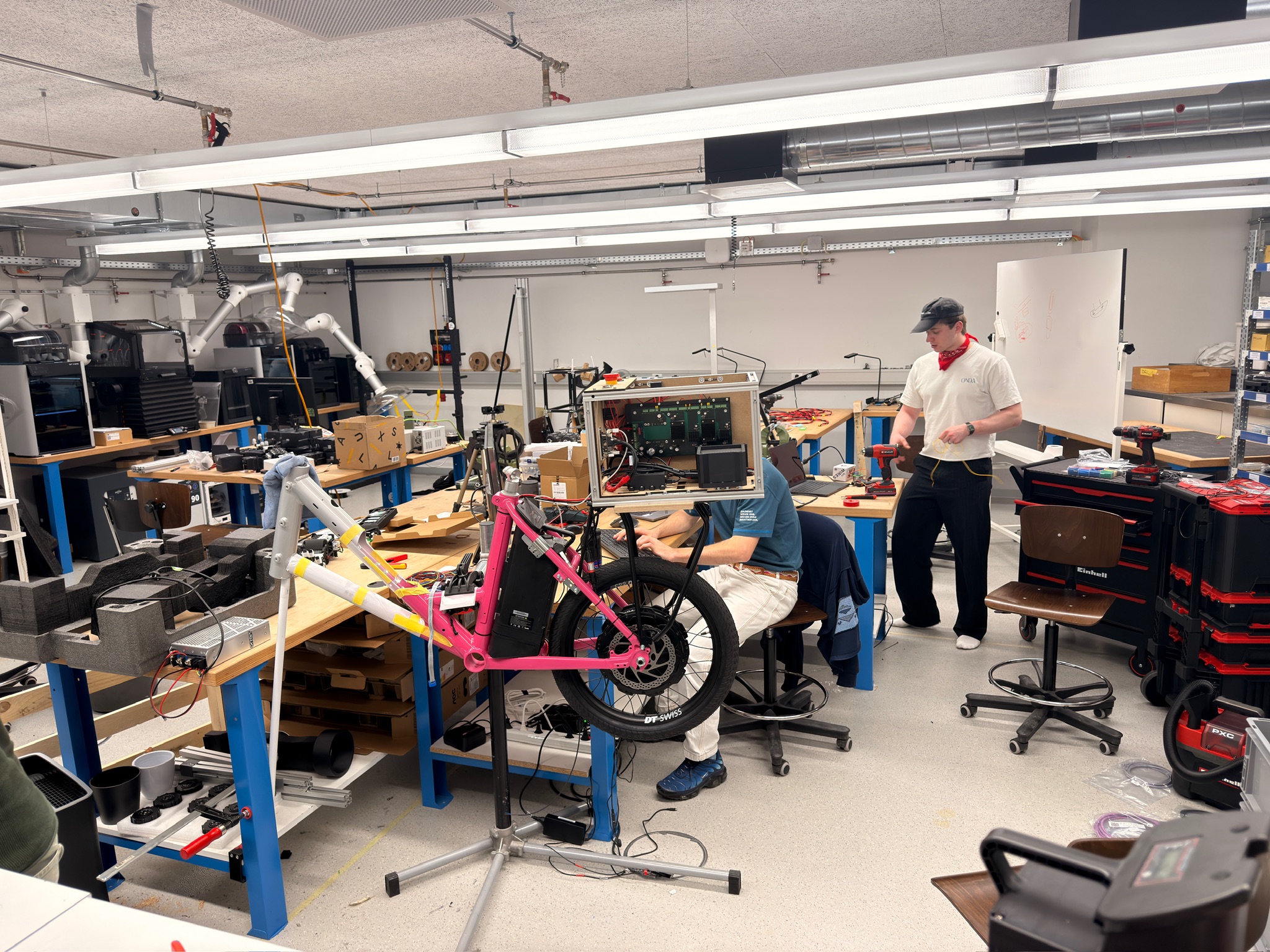
Image: The AutoBike team developed the prototype over roughly nine months, moving from sketches and CAD work to a functioning autonomous bicycle. Image courtesy of AutoBike / ETH Zürich.
Why this is not just another robot
Many autonomous mobility projects start by building a new robotic platform from the ground up. AutoBike took a different route.
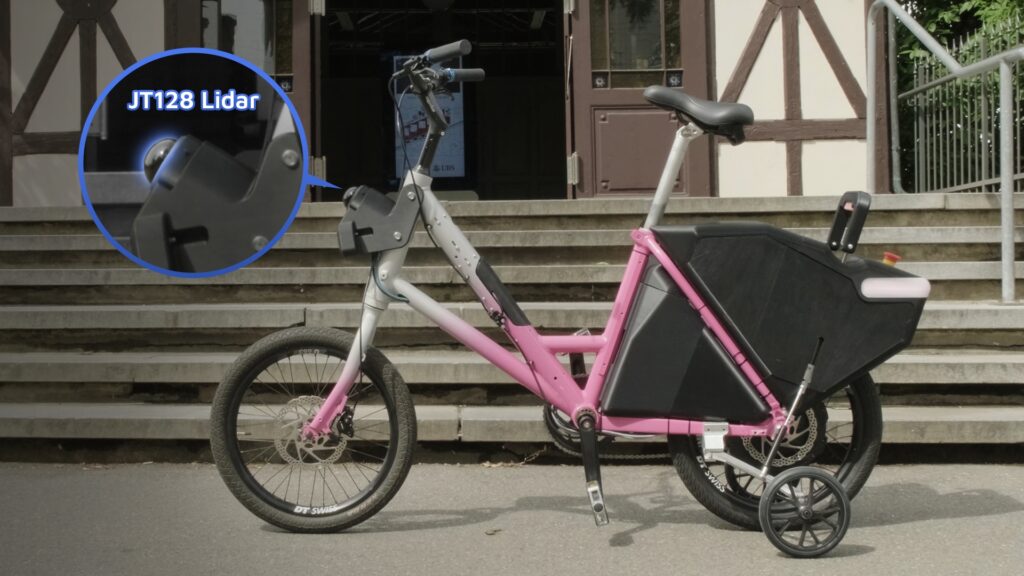
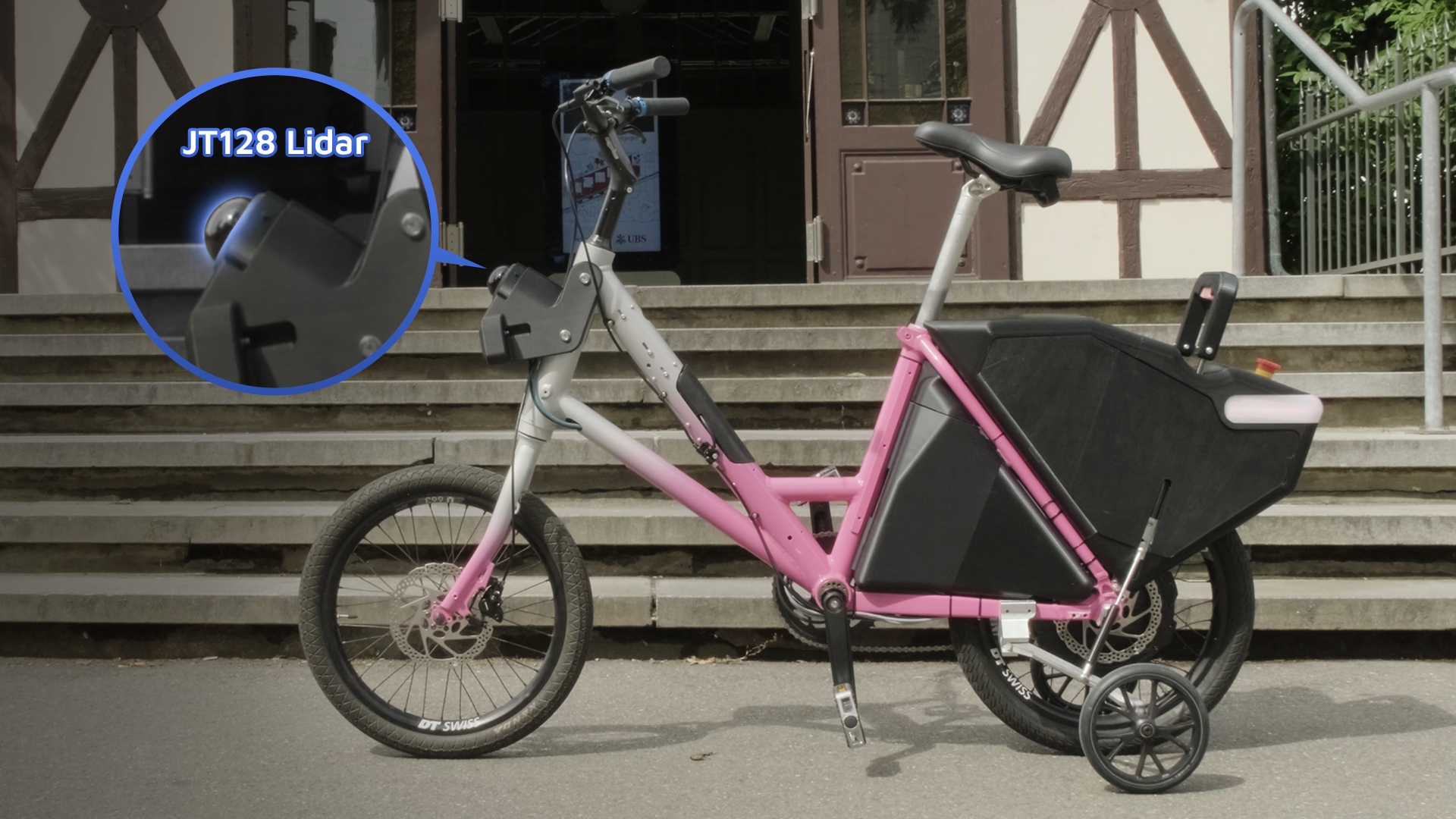
The team wanted to preserve the form and function of a normal bicycle. At first glance, the prototype still looks like a bike. A closer look reveals the systems that make autonomy possible: hidden steering, retractable support wheels, onboard actuation, a hydraulic braking system, a camera, and a Hesai JT128 lidar sensor.
That design choice matters. For bike-sharing, the vehicle cannot simply become a bulky robot. It still has to fit into a bicycle-based mobility system. It must remain compact, recognizable, and compatible with how people expect a shared bike to look and feel.
It also makes the engineering challenge harder. A bicycle is narrow. It balances dynamically. It has limited space for hardware. It moves through environments with pedestrians, curbs, parked vehicles, buildings, other cyclists, and changing light conditions.
For AutoBike, perception became one of the core technical challenges. The bicycle needed to know where it was, what was around it, and where it could move safely. It had to do this on a compact platform, without the size or sensor redundancy of larger autonomous vehicles.
At the heart of that perception system sits a single Hesai JT128 lidar sensor, used as the bike’s main sensing unit.
Why lidar matters on a bicycle-sized platform
An autonomous bicycle has very little margin for uncertainty. It is narrow, dynamically balanced, and has to move close to curbs, pedestrians, parked vehicles, and other urban objects. To ride and park safely, AutoBike needs more than a visual impression of the road. It needs reliable distance, shape, and position data.
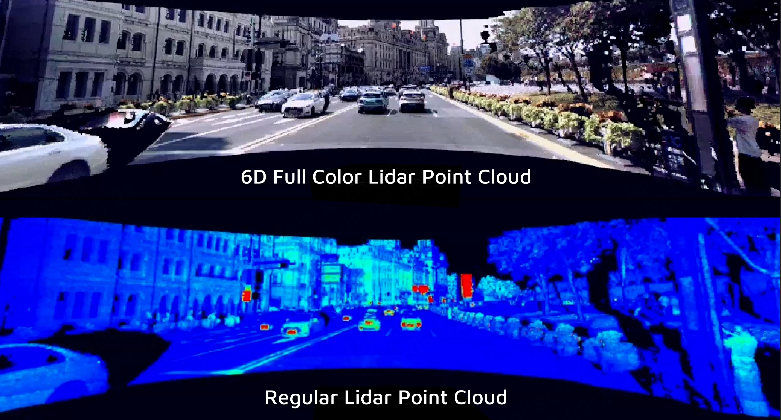
That is where the Hesai JT128 lidar becomes central to the prototype. It continuously builds a 3D point cloud of the environment, allowing AutoBike to localize itself, detect obstacles, identify free space, and compute its path in real time.
Because lidar measures distance directly, it gives the system a consistent 3D reference of the physical world around it. It also makes perception less dependent on ambient light, supporting operation across different lighting conditions, from daylight to darkness.
Without that reliable spatial layer, autonomous riding and parking on such a compact platform would be much harder to achieve.
Image: The final prototype integrates a Hesai JT128 lidar sensor, retractable support wheels, hidden steering, braking, camera, and onboard actuation while preserving the appearance of a bicycle. Image courtesy of AutoBike / ETH Zürich.
From prototype to autonomous ride
The project reached a major milestone when AutoBike completed its first autonomous ride on the ETH Zürich campus. The bicycle drove from the PubliBike station at ETH across the Polyterrasse and autonomously parked at the station near the university.
During the ride, the Hesai JT128 lidar captured the surrounding environment as a 3D point cloud. AutoBike uses that spatial data to understand its position, identify obstacles, detect open space, and calculate a safe path to its destination.
On the final day of testing, the team reported a 75 percent success rate for autonomous test runs. For a student-built prototype developed within roughly nine months, that result is a strong proof point. It shows that the concept is not only visually compelling, but technically credible.
The use case is also specific. AutoBike is not trying to solve autonomy in the abstract. It targets a real operational pain point in shared mobility: the cost, inefficiency, and environmental burden of manually redistributing bicycles.
What the project shows
AutoBike is not the final answer to bike-sharing redistribution. It is an early demonstration of what may become possible when compact urban mobility platforms gain reliable 3D perception.
A bike-sharing network is already distributed across the city. The challenge is keeping that network balanced. Today, that often requires people and vehicles to move bikes from full stations to empty ones. Autonomous redistribution could offer a different operating model: bikes that move in response to demand.
The next steps are still open. According to the AutoBike team, the project now faces questions about potential pilot testing, further system development, and cost reduction.
For Hesai, the project is a strong example of how lidar can support autonomy on compact platforms where perception has to be precise. A single Hesai JT128 lidar sensor gives AutoBike the spatial awareness it needs to localize, detect obstacles, identify free space, and plan its route. On a bicycle-sized platform, that sensing layer is not an optional enhancement. It is central to making autonomous movement possible.
Bike-sharing was designed to make cities more flexible, accessible, and sustainable. AutoBike asks what happens when the bikes themselves become part of that system’s intelligence.
For now, the answer is a proof-of-concept ride across the ETH Zürich campus. But the message is practical: if shared mobility networks are difficult to balance manually, the next step may not be more vans. It may be bikes that can move themselves.
Q&A
What problem is AutoBike designed to address?
Bike-sharing demand changes depending on location and time of day. This can leave some stations empty while others become overcrowded. Operators must therefore move bicycles manually between stations, a process that can be costly, labor-intensive, and inefficient.
How does lidar help the bike ride autonomously?
The Hesai JT128 continuously creates a three-dimensional point cloud of the bike’s surroundings. AutoBike uses this spatial data to localize itself, identify free space and obstacles, and calculate a path to its destination.
Why is precise 3D perception especially important for an autonomous bicycle?
A bicycle is narrow, constantly balancing, and has little room for positioning errors. It therefore needs reliable distance and location information to navigate smoothly, avoid obstacles, and approach a docking station accurately.
Can AutoBike already operate as part of a public bike-sharing system?
Not yet. AutoBike is a research proof of concept developed by ten ETH Zürich students over approximately nine months. The prototype completed an autonomous route on the ETH Zürich campus, but further development and testing would be required before operation in public urban environments.
What could autonomous bicycles mean for the future of bike-sharing?
In the future, bicycles that can reposition themselves could help operators respond more efficiently to changing demand. Bikes could travel from full stations to locations where they are needed, potentially reducing manual redistribution and improving availability for users.