Beyond Obstacle Detection: Exploring the Full Potential of Lidar in Railway Operations
Obstacle Detection Is Where the Conversation Begins
When lidar is discussed in the railway industry, the conversation usually starts at the front of the vehicle.
Operators, rolling stock manufacturers and system integrators are actively evaluating front-mounted lidar for trains and trams to improve obstacle detection and environmental awareness. It is a logical focus. Detecting obstacles, monitoring track intrusions and increasing awareness along the rail corridor are fundamental safety functions and closely aligned with the railway industry’s broader investment in digitalisation, automation and operational resilience.
For many organisations, obstacle detection is the first reason to evaluate lidar.
It is also the application that demonstrates the wider value of three-dimensional perception.
Once reliable environmental perception is available, the same sensing capability can support a broader range of operational challenges without requiring a completely different sensing approach. Instead of solving a single problem, lidar has the potential to become part of a wider perception strategy across the rail environment.
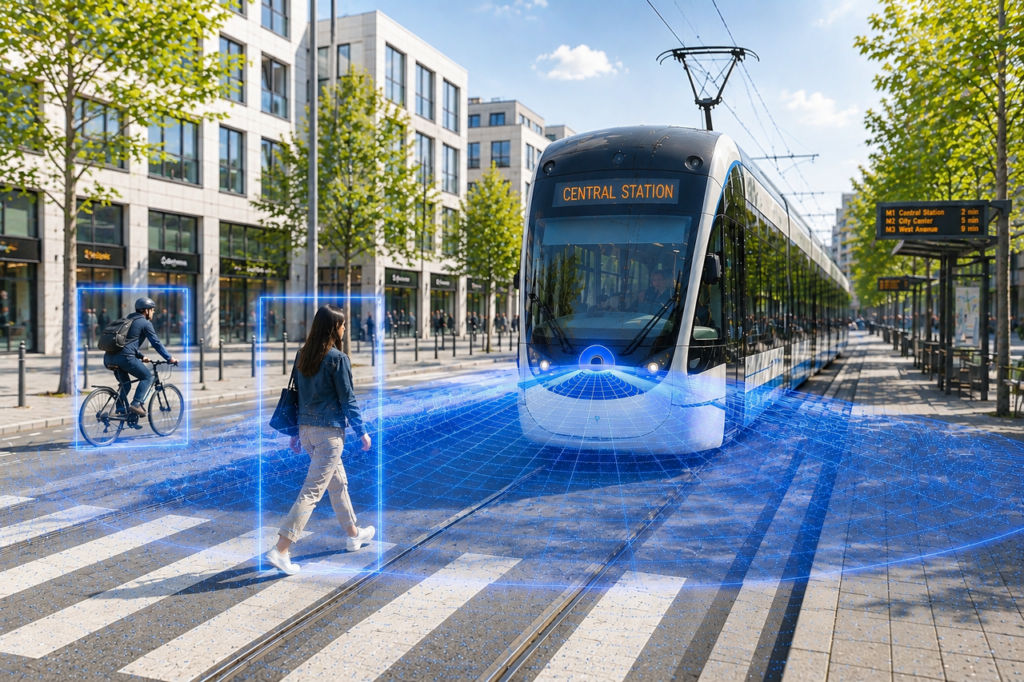
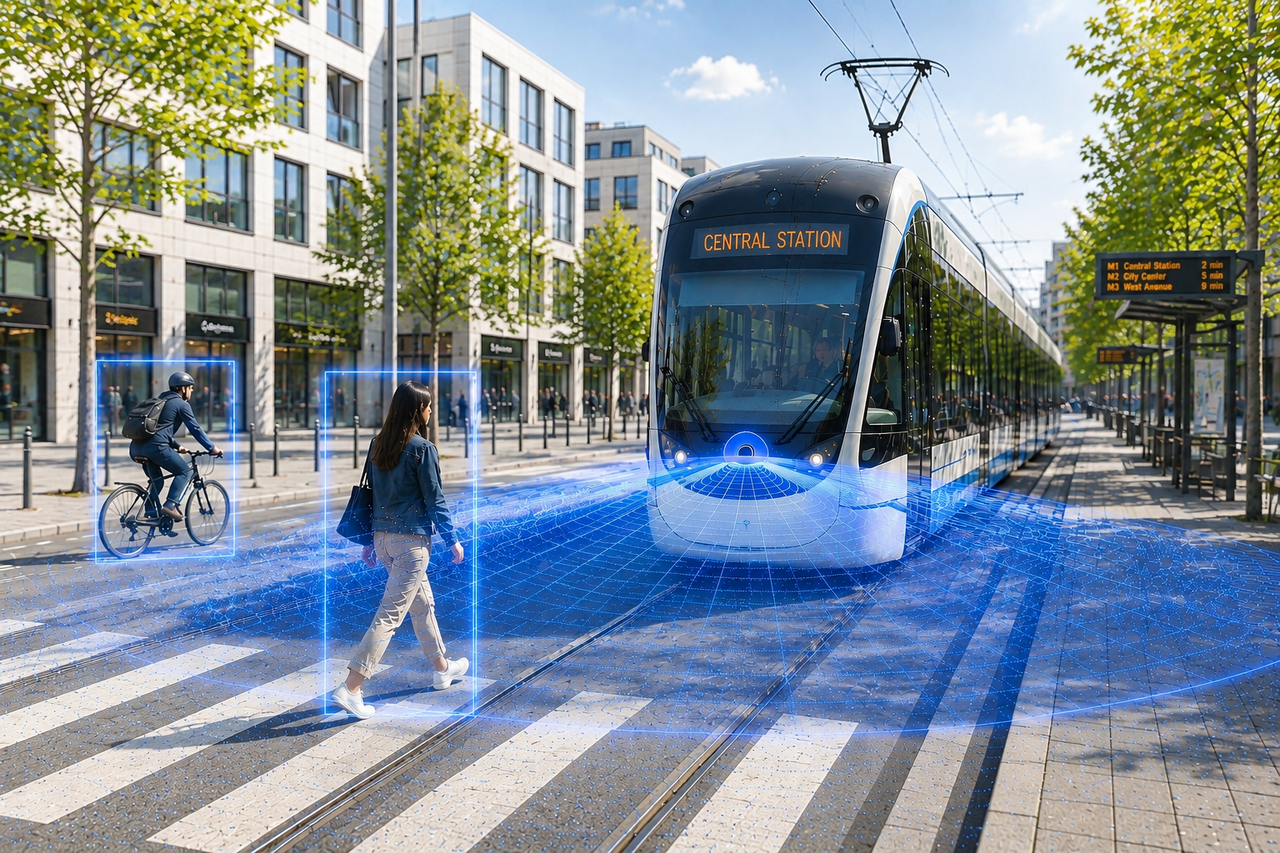
3D lidar delivers reliable environmental awareness for intrusion detection in urban rail operations.
A Layered Approach to Perception
Railways have never relied on a single source of information.
Signalling systems, operational procedures, driver observation, onboard cameras and radar all contribute to safe operation. Each provides a different perspective on the operating environment.
Lidar fits naturally into this layered approach.
Cameras provide visual context and support object recognition. Radar contributes reliable velocity information, particularly in adverse weather. Lidar adds accurate three-dimensional geometry and precise distance measurement.
Rather than replacing existing technologies, current rail projects increasingly evaluate lidar alongside cameras and radar as part of a complementary perception architecture. Each technology contributes different strengths, enabling operators to build a more complete understanding of the environment than any individual sensor can provide on its own.
| Technology | Typical Contribution |
| Cameras | Visual context and object identification |
| Radar | Velocity measurement and performance in challenging weather |
| Lidar | 3D geometry and accurate distance measurement |
| Existing rail systems | Operational and infrastructure context |
Passenger Doors: Extending Environmental Awareness
Passenger doors are among the busiest safety interfaces in any railway network.
Every day, millions of passengers board and leave trains and trams through environments that are constantly changing. Existing technologies, including door edge sensors, light curtains and cameras, remain essential components of modern door safety systems.
Lidar offers an opportunity to complement those systems by adding another layer of spatial information around the door area. Monitoring occupancy, identifying objects close to closing doors and improving awareness of wheelchairs, bicycles, strollers, luggage and other obstructions are all situations where additional environmental information may support safer operation.
While obstacle detection remains the immediate priority for many projects, door monitoring illustrates how the same perception capability can be applied to a different operational challenge using the same sensing platform.
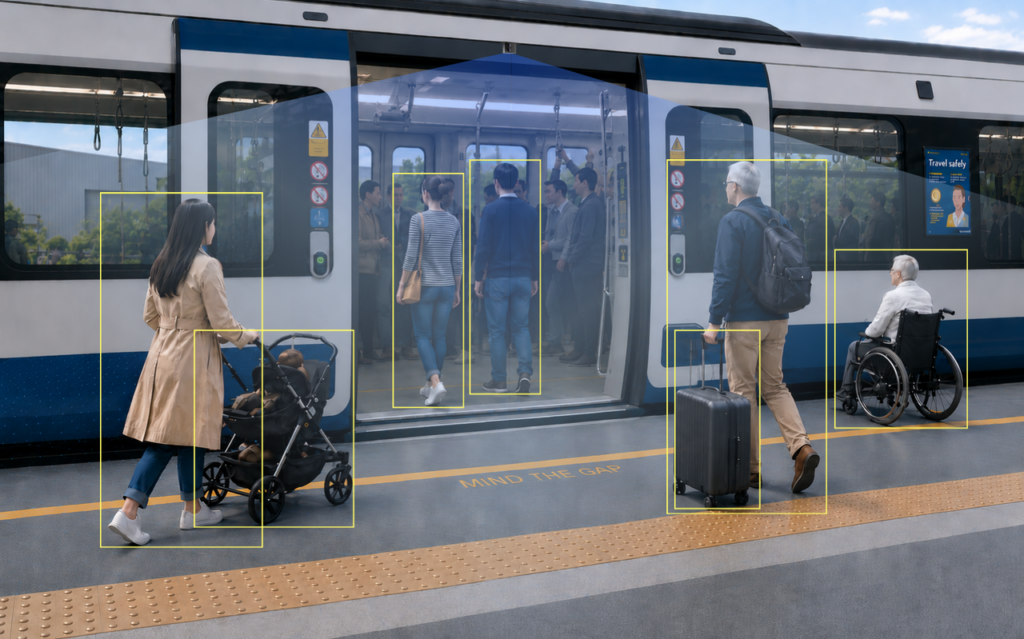
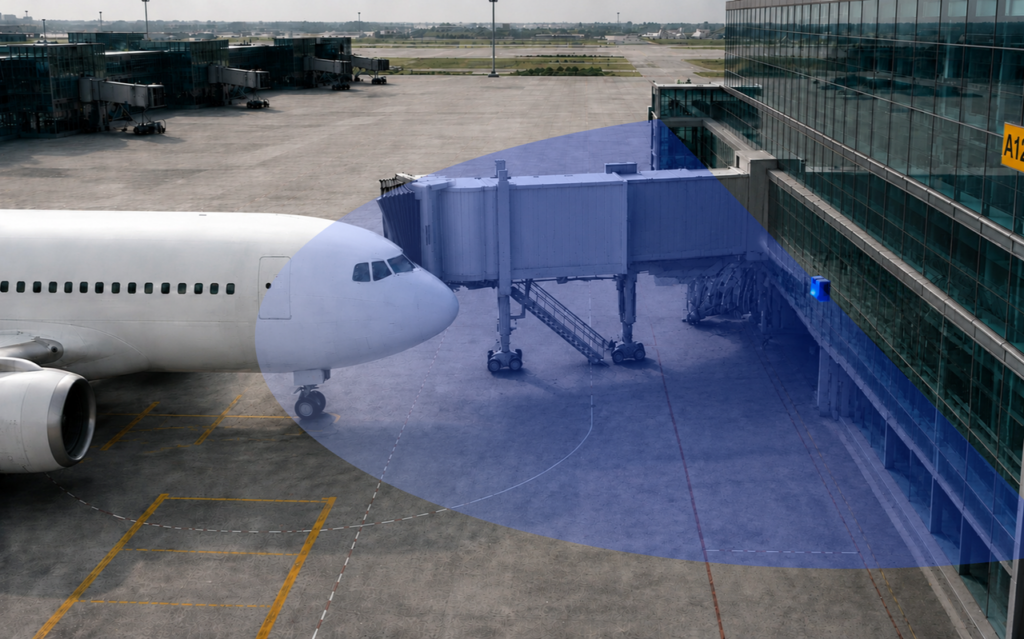
3D lidar enhances passenger safety by monitoring activity around passenger doors during boarding and alighting.
Blind Spot Monitoring Around the Vehicle
Not every operational risk appears on the track ahead.
Railway operators also need reliable awareness alongside trains and trams.
Depot activities, maintenance work, coupling procedures and movements through constrained environments all involve personnel, service vehicles and equipment operating close to rolling stock. These situations require the same understanding of the surrounding environment as obstacle detection, but from a different perspective.
Blind spot monitoring is therefore attracting growing interest as another application for lidar. By complementing existing camera systems with accurate three-dimensional information, operators can build a clearer picture of activity around the vehicle and support better-informed operational decisions.
The objective remains the same: improving awareness before a situation becomes a safety risk.
Stations, Depots and Infrastructure
The opportunity extends beyond rolling stock.
Stations, depots and other rail infrastructure present many of the same perception challenges. Operators need reliable awareness of people, vehicles and equipment moving through environments where safety and operational continuity are equally important.
Infrastructure-mounted lidar can support applications such as restricted-area monitoring, intrusion detection, depot supervision and monitoring of operational zones. Fixed installations complement existing surveillance systems while adding precise three-dimensional information about the surrounding environment.
For organisations already evaluating lidar onboard trains and trams, these applications demonstrate how the same perception capability can support multiple parts of the rail ecosystem.
One Perception Platform, Multiple Applications
Every technology enters an industry by solving a specific problem.
For lidar in railway, that problem is obstacle detection.
What makes the technology particularly compelling is what comes next.
Once reliable 3D perception is available, the same sensing platform can support multiple operational objectives. Passenger doors, blind spot monitoring, stations and depot operations all rely on understanding what is happening around people, vehicles and infrastructure.
Not every operator will have the same priorities, and not every application will be relevant to every network. The value of lidar will always depend on the operational challenge being addressed and how it complements existing systems.
The common thread is clear.
Rather than introducing separate sensing technologies for every individual task, rail organisations have an opportunity to build a broader understanding of the operating environment using a common perception platform.
The Opportunity Beyond Obstacle Detection
Obstacle detection has brought lidar into the rail conversation, and it will remain one of its most important applications.
It has also highlighted something much broader.
Reliable three-dimensional perception is valuable because it can support multiple aspects of rail operations, not just one. The same platform being evaluated for the track ahead can also contribute to safer passenger boarding, greater awareness around the vehicle, improved monitoring of stations and depots, and a more complete understanding of the wider operating environment.
As rail networks continue to modernise, the discussion is expanding beyond obstacle detection. Organisations evaluating lidar today are not simply considering another sensor. They are evaluating how a single perception platform can strengthen safety, improve operational awareness and support the next generation of rail systems.
Frequently Asked Questions
Why is lidar attracting growing interest in the railway industry?
Rail operators are looking for ways to improve environmental perception around trains, trams and rail infrastructure. While obstacle detection is currently one of the main drivers, organisations are also evaluating lidar for applications such as passenger door monitoring, blind spot awareness, station monitoring and depot operations.
Why use lidar if cameras and radar are already available?
Each sensing technology provides different information.
Cameras deliver visual context and support object recognition. Radar performs well in adverse weather and measures velocity. Lidar adds accurate 3D geometry and distance information.
Rather than replacing cameras or radar, lidar is increasingly evaluated as part of a multi-sensor perception architecture where each technology contributes its strengths.
Is lidar only suitable for obstacle detection?
No.
Obstacle detection is often the starting point because it is one of the most immediate safety applications. Once 3D perception is available, the same sensing capability may also support passenger door monitoring, blind spot monitoring, depot operations, stations and other infrastructure applications.
Can the same lidar support multiple rail applications?
Potentially, yes.
Depending on system design and operational requirements, the same lidar platform may contribute to multiple perception functions. This allows organisations to evaluate lidar as part of a broader sensing strategy rather than for a single application.
Which railway vehicles can benefit from lidar?
Current discussions include:
- Trams
- Passenger trains
- Regional rail
- High-speed rail
- Maintenance vehicles
- Rail infrastructure
The specific application depends on the operating environment and the challenges being addressed.
Can lidar also be used outside the vehicle?
Yes.
Infrastructure-mounted lidar can support applications such as station monitoring, depot supervision, intrusion detection, restricted-area monitoring and other operational environments where reliable environmental awareness is important.
Does lidar replace existing safety systems?
No.
Lidar is generally evaluated as an additional sensing technology that complements existing systems such as cameras, radar, door safety systems and signalling infrastructure.
What should operators consider when evaluating lidar?
The first question should not be which sensor to choose.
It should be which operational challenge needs to be solved.
Once those requirements are understood, operators can determine how lidar fits within a broader perception architecture alongside existing technologies.
Why is three-dimensional perception important?
Understanding the position and distance of people, vehicles and objects in three dimensions provides additional information that can support safer and more informed operational decisions, particularly in dynamic railway environments.
What is the next step for organisations considering lidar?
Many organisations begin by evaluating lidar for obstacle detection. From there, it is worth assessing whether the same perception platform could also support other operational priorities, including passenger doors, blind spot monitoring, stations, depots and infrastructure.