Why Some of the Most Important Movements in Transportation Happen at Walking Speed – And How Lidar Is Transforming Precision Positioning
From airport gates and logistics yards to ports and railway terminals, precision positioning is creating new opportunities for 3D lidar
For much of the past decade, 3D lidar has been closely associated with autonomous vehicles.
Yet some of the most interesting applications are emerging in places where vehicles move slowly rather than quickly.
An aircraft approaching a gate. A trailer backing into a loading dock. A freight wagon coupling in a rail yard. A vessel moving toward a berth. A robot returning to a charging station.
These activities may not attract the same attention as autonomous driving, but they share a common characteristic: success depends on positioning an asset accurately in relation to another asset, a piece of infrastructure, or a designated location.
Across transportation, logistics, industrial automation, and infrastructure, operators are investing heavily in automation, digitalization, and efficiency improvements. As these efforts progress, one challenge keeps appearing in different forms: understanding exactly what is happening in the final meters before an operation is completed.
Increasingly, this is where 3D lidar is proving its value.
The Last Meters Are Often the Most Difficult
Moving an asset from point A to point B is only part of the task.
An aircraft must stop at the correct gate position. A trailer must align precisely with a loading bay. A container vehicle must position itself accurately beneath lifting equipment. A robot must dock consistently at a charging station.
In many cases, the final stage of movement determines whether the operation can proceed safely and efficiently.
Historically, these activities have relied on a combination of operator experience, cameras, radar, GPS, laser guidance systems, and fixed infrastructure. Those technologies continue to play important roles.
What is changing is the level of precision expected from modern operations.
As facilities become more automated and throughput requirements increase, operators need a more detailed understanding of the environment around vehicles, equipment, and infrastructure. Small positioning errors that were once manageable can become sources of inefficiency, downtime, or operational risk.
Aviation Demonstrates the Value of Precision
Airports recognized this challenge long ago.
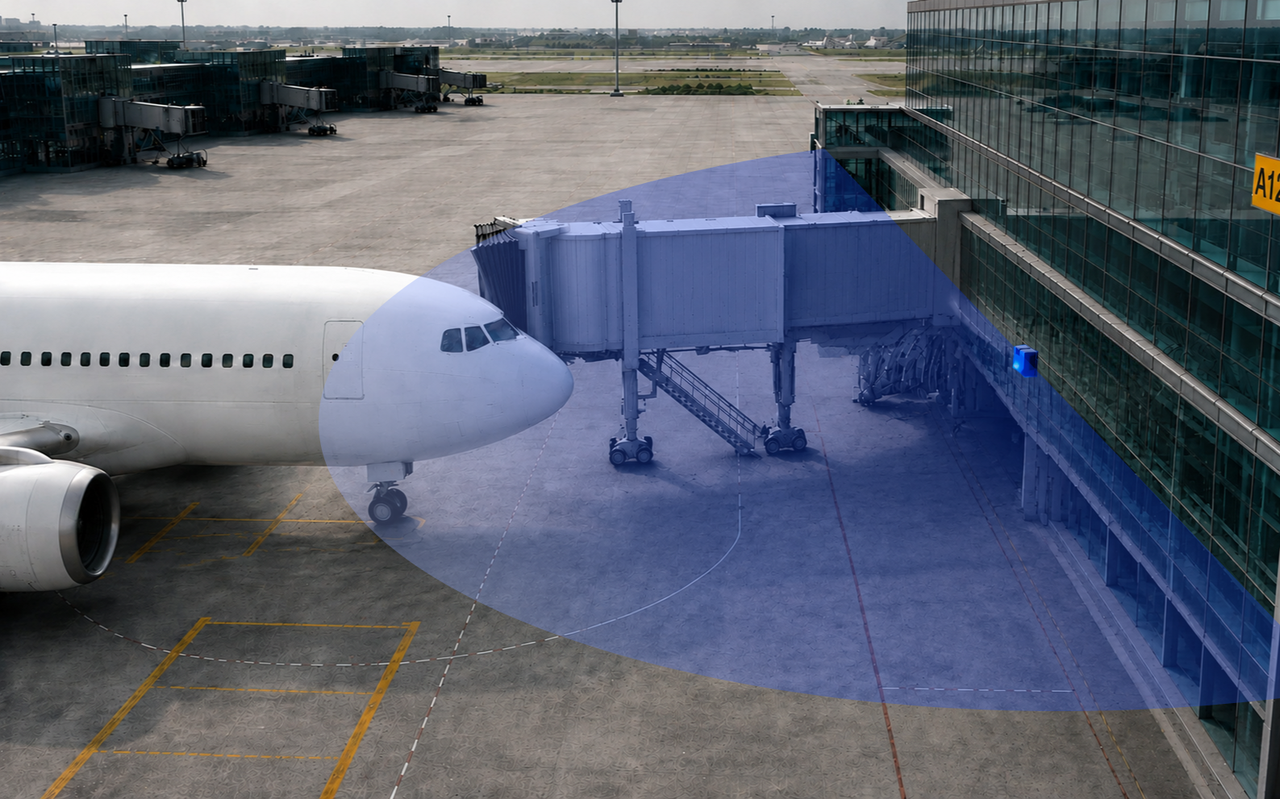
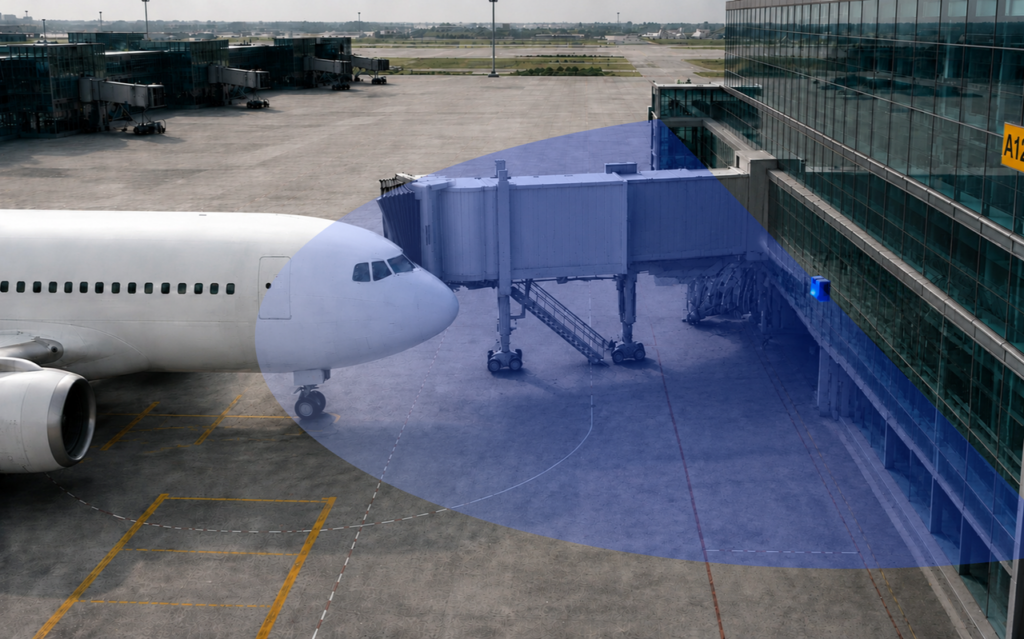
Modern Advanced Visual Docking Guidance Systems (A-VDGS) are designed to guide aircraft to precise stop positions at airport gates, helping support passenger boarding bridge alignment, ground handling operations, and apron safety.[1]
Recent developments in airport docking systems reflect a broader trend toward richer environmental awareness. New generations of systems increasingly combine multiple sensing technologies, including lidar, to improve aircraft positioning, obstacle detection, and operational visibility around the gate environment.[2]
For airports, the business case is clear. Gate capacity is limited, efficient turnaround is essential, and delays come at a high cost. Precise docking plays a critical role in this process. Misalignment between airport equipment and aircraft access points, such as passenger doors, cargo hatches, or service panels, can cause significant damage. The resulting costs, operational disruption, and potential grounding of the aircraft make precision docking a business-critical requirement.
The ability to position aircraft accurately and consistently contributes directly to operational efficiency.
The same principle is beginning to appear in other industries.
Logistics Is Turning Positioning Into a Competitive Advantage
Few sectors perform more docking operations than logistics.
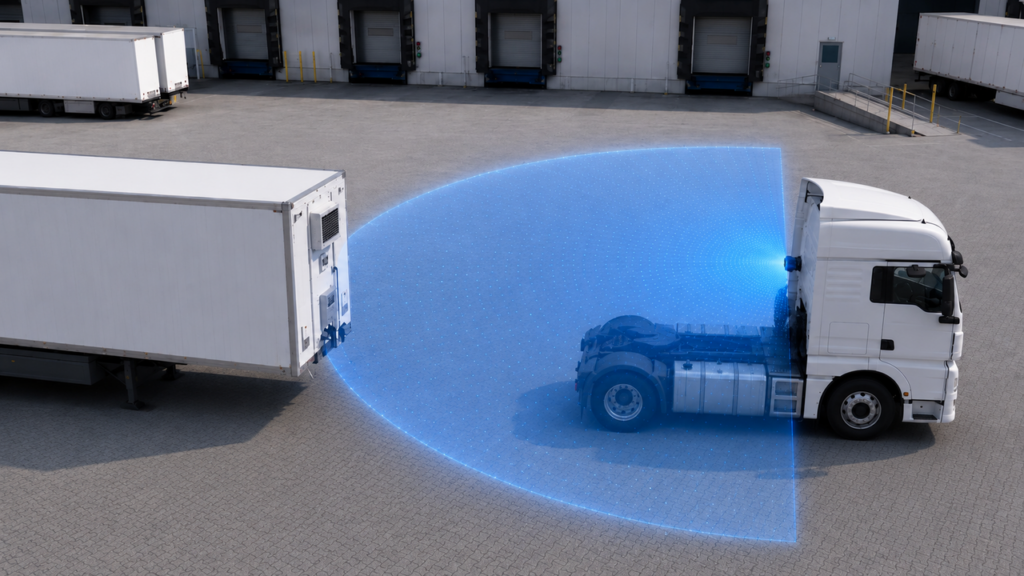
Every day, trailers are coupled and uncoupled, trucks reverse into loading bays, containers move through terminals, and autonomous vehicles navigate complex yard environments.
As logistics operators pursue higher levels of automation, positioning accuracy is becoming increasingly important.
Autonomous trailer coupling provides a useful example. Industry projects have demonstrated how lidar can support trailer alignment by helping vehicles determine the position and orientation of the trailer during reversing maneuvers.[3]
The significance extends beyond trailer coupling itself.
Many logistics operations depend on precise interactions between vehicles, equipment, and infrastructure. As automation expands, the quality of environmental perception increasingly influences how efficiently those interactions can be performed.
Ports Are Investing in Better Awareness of the Physical Environment
Port operators face similar challenges on a larger scale.
Container terminals bring together vessels, cranes, trucks, automated guided vehicles, and cargo handling equipment in dynamic outdoor environments where visibility and operating conditions can change quickly.
Many leading ports are investing in automation and digital infrastructure to improve efficiency without expanding their physical footprint. The Port of Rotterdam, for example, has become a widely cited example of how sensors, connectivity, and automation can improve visibility across complex operations.[4]
As automation increases, operators require a clearer understanding of the environment around moving assets. This is one reason advanced perception technologies, including 3D lidar, are receiving growing attention in container terminals, cargo handling operations, and automated port equipment.[5]
The objective is not simply automation.
It is improving the quality of operational information available when decisions need to be made.
Rail Freight Is Moving in the Same Direction
Europe’s railway sector is currently pursuing one of its most ambitious modernization initiatives through Digital Automatic Coupling (DAC).
The programme aims to automate the mechanical, electrical, pneumatic, and digital connection of freight wagons while creating a foundation for more efficient rail freight operations.[6]
Today, much of the discussion focuses on coupling technology and digital connectivity. Looking ahead, however, many of the goals associated with automated freight operations will depend on accurate awareness of vehicle position, infrastructure, and surrounding conditions.
Rail freight is not yet as far along this journey as some airport, logistics, or port applications.
Nevertheless, it faces many of the same challenges. As automation increases, reliable perception becomes increasingly important.
Robotics and Industrial Automation Depend on Reliable Docking
The same pattern can be found inside warehouses and manufacturing facilities.
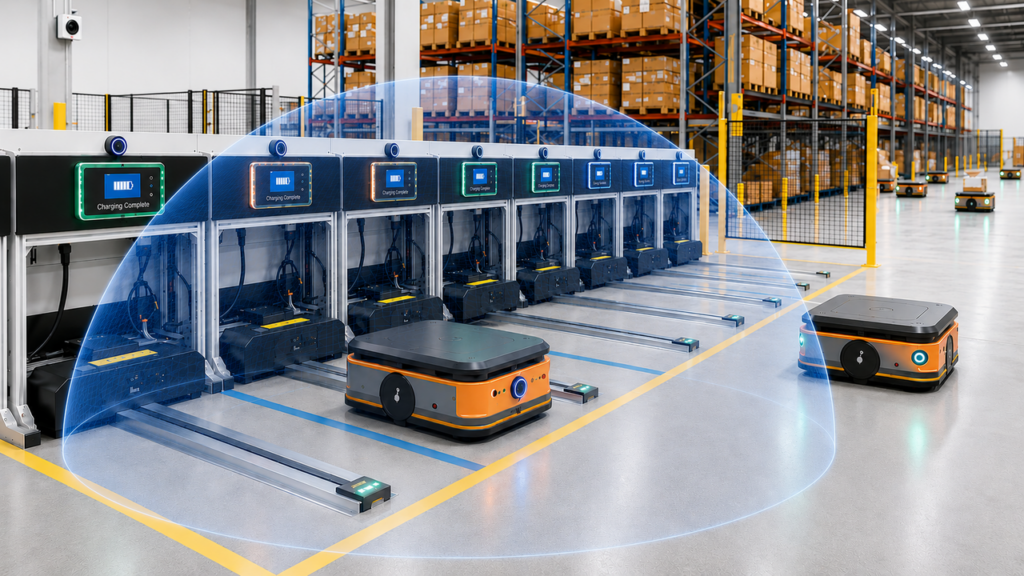
Autonomous mobile robots and automated guided vehicles must repeatedly dock with charging stations, transfer points, storage systems, and production equipment.
A robot that reaches the correct area but fails to align properly cannot complete its task.
As industrial automation scales, reliable docking becomes increasingly important to overall system performance. For operators, the value of better perception is often measured not in individual maneuvers, but in system uptime, productivity, and operational consistency.
Why This Matters for 3D Lidar
What makes these examples noteworthy is not that they use identical technologies.
It is that they reveal a common trend.
Across industries, organizations are paying closer attention to the final stage of movement. The closer an asset gets to its destination, the more important accurate environmental awareness becomes.
This is creating opportunities for technologies capable of delivering detailed three-dimensional information about the surrounding environment.
For many years, the conversation around 3D lidar focused primarily on autonomous driving. Today, the technology is finding relevance in a broader set of applications where precise positioning, alignment, and situational awareness have direct operational value.
The environments may differ. The underlying challenge is often remarkably similar.
A Market Hiding in Plain Sight
Aircraft docking. Trailer coupling. Vessel berthing. Robot charging. Automated transfer stations. Future rail-yard operations.
Viewed individually, these may seem like niche applications.
Taken together, they represent millions of daily operations across some of the world’s largest industries.
For operators, improving these interactions can translate into safer operations, higher throughput, better asset utilization, and greater operational consistency.
For the lidar industry, they represent something equally important.
A reminder that some of the most valuable applications are not always the most visible.
While autonomous driving continues to attract attention, a growing number of organizations are discovering that the ability to understand the final meters of movement may be just as important.
And in many cases, that journey starts at walking speed.
Frequently Asked Questions
What are docking applications for 3D lidar?
Docking applications use 3D lidar to help vehicles, machines, or robots position themselves accurately relative to infrastructure, equipment, or other assets. Examples include aircraft gate docking, trailer coupling, vessel berthing, AGV docking, robotic charging stations, and automated transfer points.
Why is 3D lidar well suited to docking applications?
Docking operations often require accurate information about position, alignment, clearance, and nearby obstacles. 3D lidar provides detailed spatial information that can support these requirements in complex operating environments.
Is 3D lidar already being used in airport docking systems?
Yes. Modern airport docking systems increasingly combine multiple sensing technologies, including lidar, to improve aircraft positioning, obstacle detection, and operational awareness around gates and aprons.[2]
Can 3D lidar support trailer coupling and yard automation?
Industry projects have demonstrated that lidar can support trailer alignment and autonomous coupling operations by helping vehicles determine the position and orientation of trailers during reversing maneuvers.[3]
Could 3D lidar play a role in rail freight automation?
Potentially. As initiatives such as Digital Automatic Coupling progress and rail freight operations become more automated, accurate environmental awareness and positioning are expected to become increasingly important.[6]
Which industries could benefit most from lidar-based docking solutions?
Airports, logistics facilities, ports, rail freight terminals, manufacturing sites, warehouses, robotics deployments, and industrial automation environments all involve docking and positioning tasks where 3D lidar can add value.