No Fences, No Operators: How Lidar Perception Is Making Industrial Sites Autonomous
A Flasheye and Hesai collaboration
Picture a busy underground mine. Massive haul trucks move through narrow corridors. Drill rigs cycle through positions. Maintenance crews cross active vehicle paths on foot. Shift supervisors spend significant time simply tracking where people and machines are relative to each other, making manual decisions to keep the two separated.
Incidents do not typically happen because safety rules are ignored. They happen because the site lacks the spatial awareness to enforce those rules automatically.
This is the problem at the center of industrial autonomy: not a shortage of capable machines, but a shortage of persistent, reliable perception that gives those machines and control systems the situational awareness to act safely without a human in the loop.
Stationary 3D lidar perception solves this. And the combination of Hesai’s high-capacity industrial lidar sensors with Flasheye’s perception software is making it deployable at scale, across mines, ports, sawmills, and raw material handling sites, today.
Based in Luleå, Sweden, Flasheye develops modular 3D perception software for stationary industrial applications. Together with Hesai Technology, a global leader in high-performance LiDAR sensors for industrial and automotive applications, Flasheye provides a complete perception-to-control solution for industrial sites pursuing automation and autonomous operations.
The solution addresses key industrial challenges around automation, safety, tracking, and production optimization, with concrete applications including volume measurements, object tracking, material and asset tracking, automation in raw material handling, machine and production safety, production optimization, and control of AGVs and robots.
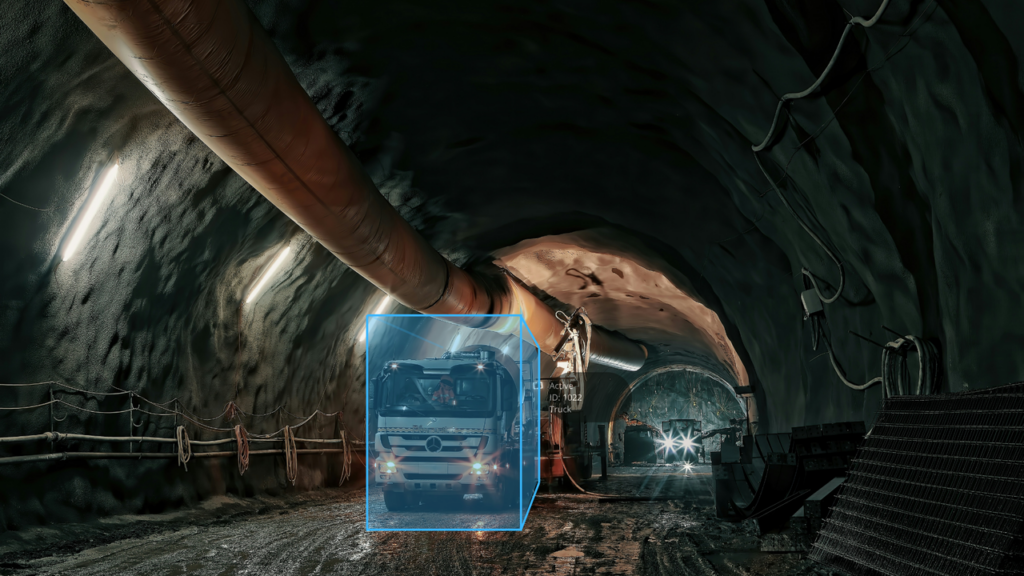
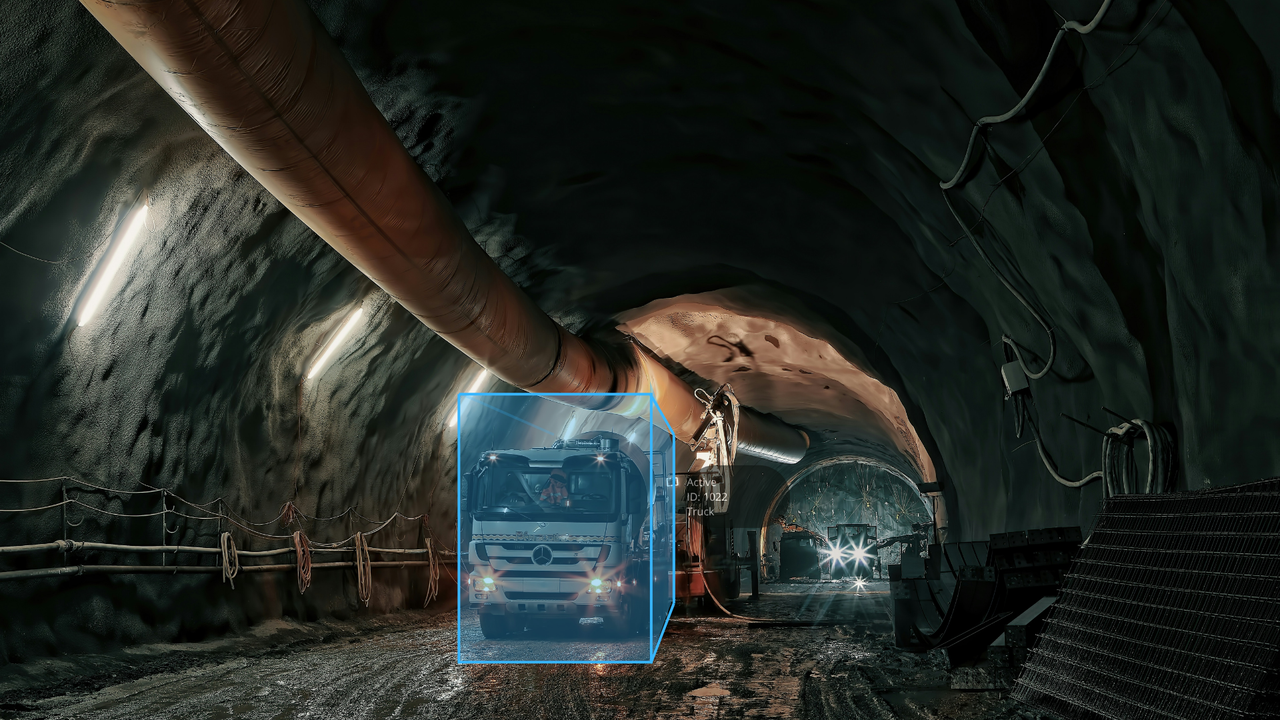
Stationary sensing solutions are building and preparing for autuonomous mines by analyzing all activities from a bird’s perspective.
Image courtesy of Flasheye.
Why the problem has been hard to solve until now
Traditional approaches to industrial safety and site awareness rely on physical infrastructure: fences, light curtains, gate interlocks, and manual supervision. These systems work, but they are rigid. Every layout change requires rebuilding barriers. Every new process interaction requires a new physical control point. Maintenance is continuous, and the systems do not produce data that other automation systems can act on.
Camera-based solutions offer some improvement, but they struggle in the conditions where industrial sites operate: dust, steam, low light, and rapidly changing scene content. They also cannot provide the 3D spatial measurements that machine control systems require.
The missing piece has been a sensor and software combination capable of monitoring large industrial spaces continuously, in three dimensions, with enough resolution and reliability to serve as the primary input to control systems rather than just an alerting layer.
What Hesai sensors make possible in these environments
Hesai’s high-capacity 3D lidar sensors bring a new level of spatial coverage and data quality to stationary industrial applications. Depending on the lidar model, the single sensor can help manage an area of an area of 5,000m² and 50,000 m² per unit, covering zones that would previously have required multiple sensors, physical barriers, or dedicated personnel. The sensors operate reliably across the full range of industrial conditions: dust, vibration, variable lighting, and temperature extremes present no meaningful limitation.
Hesai sensors are particularly well suited for large-scale industrial installations. The combination of high performance and competitive pricing makes it practical to deploy multiple sensors across an entire site, covering terminals, production floors, and outdoor areas in full, without the cost constraints that have historically limited lidar adoption to single-point or pilot deployments. For sites where full-area coverage is the goal rather than a single use case, Hesai’s price-to-performance ratio makes that ambition achievable.
The point cloud data produced by Hesai sensors is dense and accurate enough to support precise object classification and tracking at the distances and object scales relevant to industrial operations, from a pedestrian at 25 meters to a haul truck at 200 meters, depending on the lidar model.
This range and resolution combination is what makes single-sensor coverage of large industrial zones practical rather than theoretical.
Where Flasheye fits: from point cloud to control signal
A point cloud is geometry. It describes what is in a space but does not interpret it. Turning that data into something a control system can act on requires software that classifies objects, applies zone and rule logic, tracks movement over time, and delivers structured outputs through the interfaces that industrial infrastructure already uses.
That is what Flasheye provides. The platform connects directly to Hesai sensors,processes the incoming point cloud in real time, and produces structured perception outputs: object positions, speeds, classifications, and zone status, delivered continuously through MQTT, OPC UA, UDP, and PLC interfaces. All major industrial protocols are supported out of the box. No custom integration work is required for standard deployments.
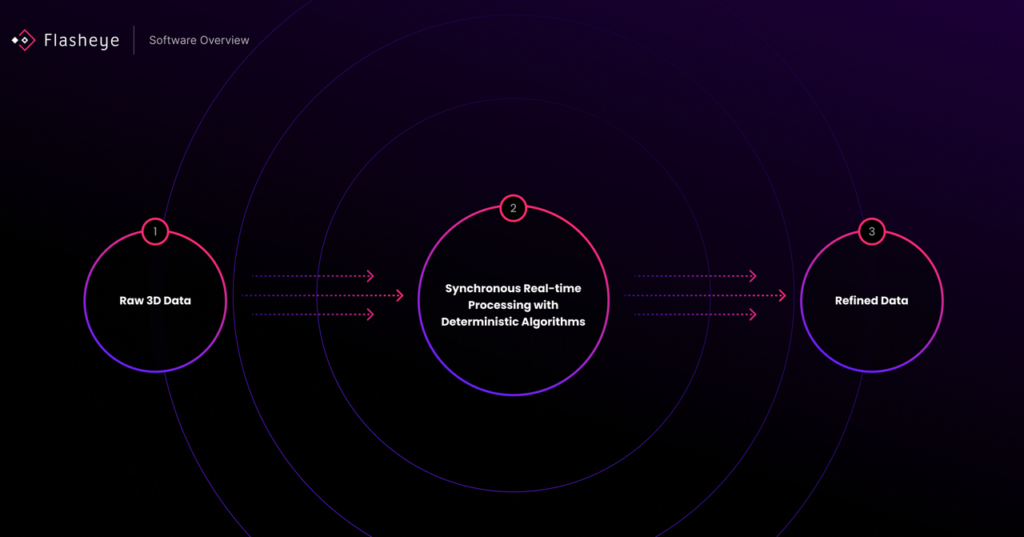
Perception software translate the 3D data so it can be understood and used by machines, systems, and humans.
Image courtesy of Flasheye.
The result is a complete perception-to-action pipeline: the sensor captures the scene, Flasheye interprets it, and the control system responds.
A haul truck approaching a restricted zone triggers an automatic slowdown. A person entering a machine cell stops the equipment before contact is possible. A loading sequence advances to the next step when the previous one is confirmed complete. All without an operator making the decision.
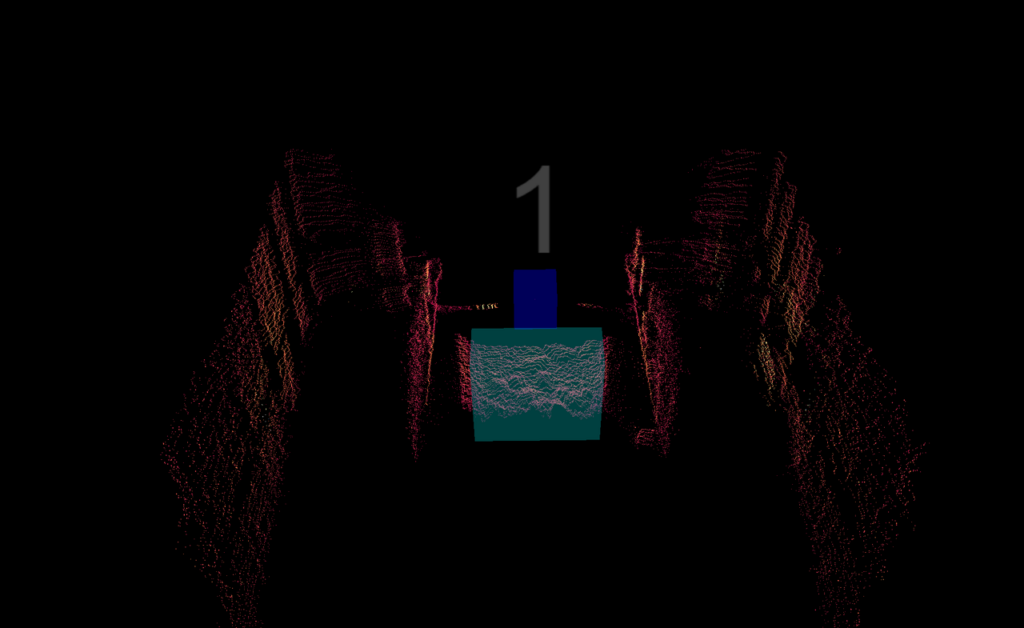
With today’s sensors, every centimeter of the operations and material can now be tracked, something that has been challenging in the raw materisl industry.
Image courtesy of Flasheye.
The operational impact in practice
Sites using this combination are seeing a shift in how their operations function, moving from reactive safety to proactive, automated control.
Mining
In mining environments, where the primary goal is removing people from proximity to autonomous or semi-autonomous heavy equipment, lidar-based zone enforcement eliminates the need for physical fencing around machine operating areas. One sensor installation can replace what would otherwise require hundreds of meters barrier infrastructure and safety interlocks. Modification for new layouts takes hours instead of weeks.
Ports
In ports and logistics terminals, persistent tracking across the full terminal area reduces the number of operators needed to manage vehicle and cargo flow. Loading and unloading sequences that previously required manual coordination can be triggered automatically based on confirmed spatial conditions.
Sawmils
In sawmills and raw material processing facilities, real-time 3D measurement of material positions enables automated feed control with tighter tolerances than manual operation allows, reducing waste and improving throughput consistency.
Across all of these environments, the reduction in manual intervention is directionally significant: fewer people making real-time coordination decisions, fewer people present in high-risk zones, and a control loop that responds in milliseconds rather than the seconds or minutes a human response requires.
The path to full autonomy runs through stationary perception
Autonomous vehicles, robotic systems, and unmanned operations all depend on one thing: the site knowing what is happening within it, persistently, at a level of precision that machines can act on. Mobile sensors help, but they do not provide full coverage. They do not maintain context across an entire operational area. They do not persist when the vehicle stops or leaves.
Stationary perception fills that gap. It is the fixed spatial intelligence layer that the rest of the autonomous operation stack builds on. Sites that establish this foundation are the ones best positioned to introduce AGVs, reduce shift staffing in hazardous areas, and extend autonomous operation further into their processes.
The Hesai and Flasheye combination makes this foundation deployable today. The hardware is robust enough for the harshest industrial environments. The software delivers the industrial protocols and integration points that operational technology teams require.
The configuration and deployment process is measured in days, not development cycles.
Q&A – Lidar in Industrial Autonomy
Why is stationary lidar specifically important for industrial autonomy, rather than sensors mounted on vehicles or machines?
Stationary sensors provide persistent, full-area coverage from a fixed reference point. Mobile sensors on vehicles or robots only see what is within their current field of view and lose context as they move. For a site to operate autonomously, the site itself needs to know what is happening at all times, not just individual machines. Stationary lidar provides that site-level awareness as a continuous data stream.
Why is this approach relevant now when lidar-based systems have existed for years?
The sensor hardware has improved significantly. Current high-capacity sensors from manufacturers like Hesai offer the range, resolution, and environmental robustness needed for large industrial spaces at a price point and reliability level that makes deployment practical. Combined with software that handles the full processing and integration layer, the total system is now deployable without the custom development effort that earlier generations required.
How do Flasheye and Hesai complement each other in a deployment?
Hesai provides the sensing hardware: the physical sensors that capture 3D spatial data from the environment. Flasheye provides the software that transforms that raw data into structured, actionable outputs and delivers them through industrial interfaces. Neither component alone solves the operational problem. Together they form a complete, deployable perception-to-control pipeline that integrates with existing site infrastructure.
Does this approach require changes to existing control systems?
No. Flasheye outputs data through standard industrial protocols (MQTT, OPC UA, UDP, PLC). Existing control systems and PLCs receive structured inputs in formats they already understand. The perception layer sits above the sensors and below the control systems, and does not require changes to either.
How does this handle the complexity of real industrial environments? Dust, reflections, moving vehicles?
Hesai sensors are rated for demanding industrial conditions. Flasheye’s detection engine is parameter-based rather than model-based, which means it does not degrade when environmental conditions vary. There is no trained model that can overfit or fail on unfamiliar scene content. The system produces consistent output across the full range of operating conditions from the first day of deployment.